Have you heard the saying that 50 is the new 40? These expressions always make me laugh.
I am giving this blog post the title Hard Money is new Smart Money because in the past year, I have been involved in a few transactions that have involved Hard Money, and they have been very successful both for the borrower and the lender.
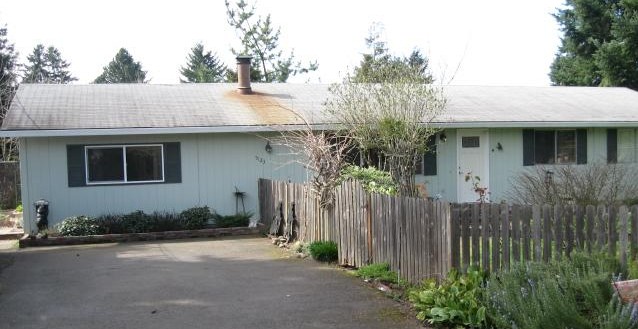
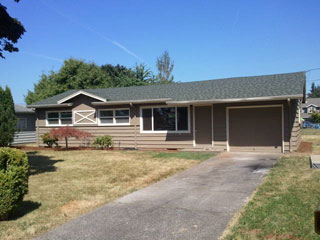
One of the transactions was an investor purchase of a bank owned property that was not financeable in its "fixer" condition. My client purchased the property with a Hard Money loan, she hired a contractor to make the repairs and she sold the property for a profit in short order.
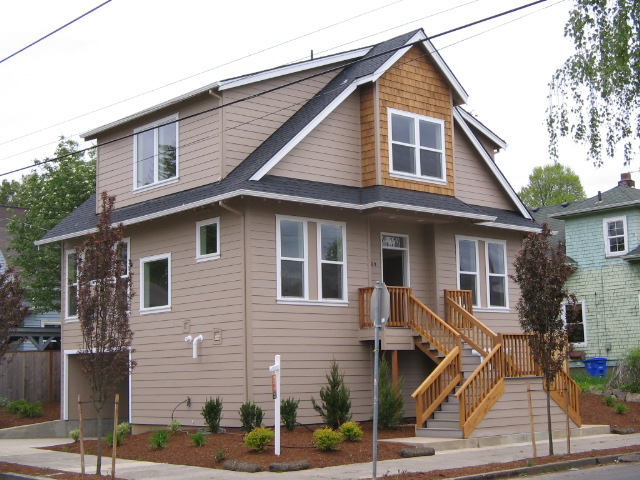
Another one of my clients purchased a tear down house using Hard Money. He tore down the house and re-activated 2 tax lots that were associated with the property. He paid off the hard money loan when he was able to re-sell the lots.
Hard Money by definition is a high interest loan with points. In our local Portland Real Estate Market, hard money rates are about 12% per year with 2 to 4 points paid upfront. For example, if a borrower wanted to borrow $100,000 for one year, he would pay 3,000 upfront and 1,000 per month in interest. He would pay $15,000 for the loan over the period of one year.
Borrowers typically use hard money for short term financing because banks are not interested lending on these projects. From the point of view of the lender, either an individual or a group of people with cash, Hard Money loans are very profitable and 100% secured by real estate.
Hard Money lenders can expect to make 12 to 18% per year on their investments, and their investment is backed by the underlying real estate. In most cases their is a note and trust deed associated with the transaction, so if the buyer defaults, the seller is able to take back the property.
From the point of view of the borrower, Hard Money is the only way to finance certain transactions.
Hard Money loans can be a win/win situation, and this is why Hard Money is the new Smart Money.
If you have any questions about Hard Money or being a Hard Money Lender, please let me know.
There are some outstanding opportunities for real estate investors in Portland these days. I frequently get calls from would-be buyers who want to buy a home, but they do not fit into the underwriting box that banks require. Banks want to see 4 things: Decent Credit History, Income that can be documented for 2 years, Low debt, Some downpayment money and reserves.
The buyers that call me usually have 3 out of the 4, but for one reason or another, they can't meet the banks strict requirements.
Here is what I need to help these buyers. I need investors who can purchase homes for these buyers, either cash or financed purchases, and then rent to the buyers for a period of time until the buyers can meet the bank's criteria. In other words, the investor buys the home and enters into a lease/option agreement with the potential buyer.
You might ask, why would this me a good deal for the investor? And I would reply: The investor has a rental property that has upper tier tenants, an extra large non-refundable deposit (option fee) and a good possibility of exiting the transaction in a few years at a sweet profit.
Your comments are always appreciated.
Chase Bank is aggressively pursuing short sales with some "under water" home owners.
Would you do a short sale for $15,000?
I must admit that I was a little bit skeptical when my client David called me about 3 months ago with a letter from Chase in hand. The letter said that Chase would pay my client $15,000 if we were able to successfully execute a short sale. The exact language that Chase used was:
You still have options, and we want to help. We have a new program that could be right for you. Don't lose hope--you may be able to avoid foreclosure and make a fresh start.
You may be able to owe nothing more on your mortgage and get $15,000 after you sell your home....
The seller signed the listing paperwork on 10/21/11, we received an offer on 11/7/2011, and we closed the transaction on 12/29/11. Wow. What a shocker. Chase was very pro-active and did a fantastic job. The buyer's agent was on the ball and the buyer and seller did what they had to do in a timely manner. Short sales are usually a challenge, but this one was fantastic. I would work with Chase again in a heartbeat. They were able to get a short sale done in about the same amount of time as a traditional sale... about 6 or 7 weeks.
Kudos to Chase. I would be happy to participate as a real estate broker in another Chase Short Sale.
My client got paid $15,000 for doing the chase short sale.
The buyer got an excellent price on a great house.
Booyah!
Portland Real Estate Market Update: December 16th 2011
It is winter and inventory goes down in the winter because it is not the best time to sell, but RMLS is reporting that the active listing count is at its lowest point in 3 years. Take a look at the Inventory in Months chart below, courtesy of RMLS:
Why is inventory so low? Well, for starters sales are up. Closed sales increase 18.9% when comparing November 2011 with November 2010.
Second, new listings are down. Year to day new listings are down 26% in 2011 compared to 2010.
Supply is down, demand is up. Either one of these factors is enough to affect price, but the combination of lower supply and higher demand has had a positive effect on price. From October to November 2011 the median sale price was up 3.3%. However prices fell 4.6% over the past 12 months.
Who in their right mind would want to sell right now? Banks, owners who are under water (short sales), builders, investors who flip properties, sellers who want to move up, down or out of the area, sellers who are getting the squeeze because of relatively high mortgage rates vis-a-vis current mortgage rates or adjustable rate mortgages, etc. In other words, the only people selling right now are selling because they have to sell, or they are looking to re-position their assets.

Even though prices have been going up lately, we will still probably see our winter capitulation cycle where sellers who were not able to sell during the high season give up and sell at whatever price they can get. So I believe that we will see a dip in prices over the next couple of months. However, when spring comes, look out!
This is the most exciting real estate market I have seen in the past 20 years. Opportunities abound!
Condos in the Pearl District are still holding their own. There are currently 124 active listings (as of 12.11.2012), 37 pending listings and 51 condos have sold in the past 3 months. This equates to about 17 condos selling per month with an inventory of about 7.3 months. This inventory level is about average for the Portland Metro Area.
THE AVENUE LOFTS #326, 815sf, $219,900
The average price per square foot of condos sold in the past 3 months is about $380/sf. This still is some of the most expensive real estate in the region.
The Pearl District has not been affected as much as the rest of the city by the downward spiral brought on by short sales, foreclosures and bank owned properties. Surprisingly only 30 of the 212 active, pending and sold properties in the past 3 months were short sales or bank owned. This means that only 14% of the properties on the market in the Pearl District are "distressed". This is about half the average in Portland.
Most people recognize that now is not a great time to sell, so the only people who are selling really have to sell: banks, short sellers, developers and homeowners who are not able to wait for a better market.
For bargain shoppers, the best opportunities are definitely with the distressed properties. Bank owned properties have been selling for about $301/sf short sales are selling for $292/sf.
This is a follow up piece to an article that I published in April of 2011 about cooperative short sales. Well the good news is that the transaction did close, and the seller did receive the relocation bonus. The bad news is that it took almost as long as a traditional short sale.
The only time savings that I noticed was due to the fact that the buyer had already submitted a hardship letter to the bank, and the bank was willing to consider the short sale. The real benefit that I noticed was that the bank was in control of the pricing. They did a BPO (Broker Price Opinion), and they allowed us to list the property at a price that they considered reasonable. The price reductions we pre-approved, so we did not get any push back from the bank once we submitted an offer. This was also a benefit because the buyer had a pretty high level of confidence that the bank would accept the pre-approved offer, so he was willing to stick around. One of the big problems associated with short sales is that buyers frequently walk away after a few months of waiting.
The "cooperative short sale" process with Bank of America was still rather slow an cumbersome, but greatly improved over my previous dealings with this bank. I was quite frustrated at times because I had a hard time getting the bank's representative to call me back. I would make several calls sometimes without getting a call back. Also, I was never able to reach the banks representative directly.
I am currently involved with "cooperative short sale" on steroids. Chase is offering sellers up to $15,000 to participate in short sales. I have seen the letter that they are sending out. Now I am not 100% convinced yet, but my confidence is building. So far dealing with Chase on their cooperative short sale has been a breeze, and I have been able to reach the account manager on the phone directly a few times. This is truly shocking to me. I guess I will be doing another follow up on this article in 2012, if we are able to close this tranaction. But so far, it looks like Chase is very motivated to help sellers to participate in short sales.
SE Portland Referral Group
I Take The Lead (Mall 205 Group)
Meetings on Fridays at Noon at Portland Seafood Co. Restaurant
9722 SE Washington St Portland, OR 97216
About 5 years ago, one of my co-workers at John L. Scott Real Estate was telling me about her referral group. I must admit that at the time, I did not even know what a referral group was. A referral group is a group of business men and women who meet on a regular basis to refer business to each other. Well, my co-worker was telling me that a large percentage of her business leads were coming from her referral group.
As a Realtor and a small business owner, I was intrigued by the concept, so I went online and I searched for a Portland Referral Group. I found a local group and I tried to join it, but the group already had a Realtor, so they would not let me join.
Fast forward about 5 years. I was invited to hear a guest speaker at the Beaverton I Take The Lead referral group by one of my co-workers at JMA Properties. The speaker was Ronnie Noize, and she spoke about networking, and I was fired up to try to join referral group. I contacted Becky at I Take The Lead, and she told me about an I Take The Lead Group that was looking for a Realtor, so I signed up right away.
I have been a member of an I Take The Lead referral group for a few months, and it has been a very rewarding experience. I have made some good friends who share a common goal of referring business to one another. I have done business with Lucia, Chris and Darren, and I look forward to doing business with Jeremy and Charity soon. We meet every Friday at Noon at the Portland Seafood Company (Formerly Newport Bay) Restaurant at Mall 205. Come join us!
Our group has a:
Realtor: Brian Porter
Mortgage Broker: Darren Balogh
Financial Advisor: Jeremy Shepherd
Computer Expert: Chris Moore
Greeting Card Consultant: Lucia Soppe
Health and Diet Coach: Charity Husk
I Take The Lead also has many other chapters throughout Portland and other cities in the Pacific NW.
We are actively looking to expand our group with small business people from many industries including: automotive, accounting, banking, construction, medical, dental, legal, retail and any type of business that would benefit from word of mouth referrals.
Please give me a call at 503-810-2219 if you would like to be my guest at an upcoming meeting.
Thanks,
Brian
____________________________________________________________________________________________________
Here is a recent article written by Lucia Soppe:
Since CEO Kody Bateman founded the company in 2003, SendOutCards has been changing people’s lives one card at a time. We are an online greeting card and gift company with over 43 million cards sent, making us the largest first-class mailing company in the U.S. and one of the fastest growing network marketing companies in the world.
The prompting to reach out and touch someone’s life is something every person experiences. SendOutCards is enabling people to act on these promptings by providing an online service which helps you send personalized, printed greeting cards and gifts as a way to make a difference in the lives of others.
It's Lucia's passion to share this with people and help them get on their way to better relationships and more heartfelt connections!
http://www.youtube.com/watch?v=JJic3b_MU9Q&feature=youtu.be
If you have the ability to buy rental property, you might want to consider a few things. Prices have dropped dramatically and we may be testing the bottom of the real estate prices. Interest rates are close to 50 year lows. Rents are going up and vacancies are going down. People who have been pushed out of the ownership market have moved into the rental market.
Here is an example of one of my listings that I think would make a good rental: 18121 SE Lincoln St., Portland, OR.

Purchase Details:
List Price: $135,000
Closing Costs: 2,000
Down Payment: 33,750
Loan Amount: 101,250
Monthly Expenses:
Mortgage Payment: $513
Taxes: 171
Insurance 50
Utilities 100
Maintenance 50
Vacancy Factor 30
Total Monthly Expenses: $914
Monthly Gross Income: $1,000
Net Monthly Income $86
We assume a 4.5% interest rate on a 30 year fixed mortgage in this example.
The numbers that we have used for the rental are $100 less than the average rental amount on Rentometer.com, so we are taking a very conservative approach in this study.
Estimated sale price at the end of 10 years: $165,392. This is about 2% appreciation per year, and once again, this is a very conservative number.
We also assume a 2% increase in rents per year and a 2% increase in expenses per year.
The Internal Rate Of Return on this investment at a 5.3% cap rate (the current cap rate of this property) would be 10.92%.
IRR=10.92%
If you are more bullish on the starting rental amount, the rental increases or the appreciation, the IRR could easily top 15%.
If you would like for me to send you the details of this investment opportunity, please let me know. Where can you make over a 10% return on your investment these days?
Call Brian 503-810-2219
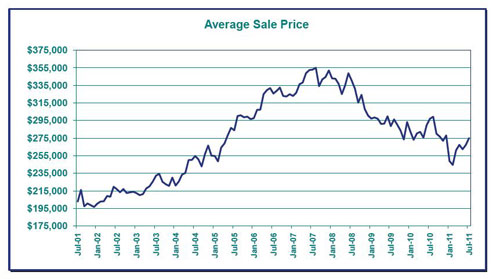
This graph clearly shows that the average sale price has been going up in Portland in 2011. This graph was published in the July 2011 Market Action report that is put out by RMLS.
I do have some concerns about this graph and real estate values in Portland. First, it appears that the price of 275K is a point of major resistance. When will Portland Real Estate be able to breach that price? We are coming to the end of our high season, and prices typically go down in the winter. If we do breach the 275K in the next month or two, then the 275K price might serve as point of support. However, if we do not break out above 275K then we might re-test the bottom price of about 250K.
The national news regarding the debt ceiling, the loss of the AAA Bond Rating of the USA and the sharp decline of the stock market in August are weighing on the local real estate market. I noticed some apprehension and lack of confidence from buyers during the first part of August. In the past week or so, things have picked up a bit, but the market is still fragile and the recovery is questionable at best.
Some people are starting to say that the market has bottomed out (see the article on Oregon Live dated August 16, 2011), but I will rest a lot easier in the spring of 2012.

Some other interesting facts are: Closed sales (number of units) were up 21% when you compare July 2011 with July 2010. The average sale price declined 7.4% over that same period of time. The average sale price went up to $275,100 from $267,100 from June to July of 2011.
Beat-Down: Lollapalooza Moment a concert season reality check
by Wade Nkrumah
It’s finally hitting me: the summer concert blues.
I went missing-in-action during mid-April’s Coachella ’11, ending a seven-year run of consecutive trips to Southern California’s Coachella Valley. That’s why I needed a Lollapalooza Moment to slap me to my I-wish-I-was-there senses.
It was a timely reminder that it’s not too late. The summer concert festival circuit makes its way early next month to the Great Pacific Northwest, with Bumbershoot in Seattle and MusicfestNW in Portland.
This month was Lollapalooza ’11, marking my 19-year-old niece’s maiden voyage on the festival circuit.
At Chicago’s Grant Park, she does what thousands at such festivals do: asks a random stranger to take a picture of her and a friend. Dude obliges, then bolts into the crowd with her months-old iPhone 4.
My niece, an athletic college-level soccer player, takes off after dude without hesitating (or thinking, her mom and sisters might say). She runs down dude, grabs him from behind, tearing his shirt, and punches dude in the face, nearly knocking down his throat the still-lit, half-smoked cigarette in his mouth. She grabs her phone and walks off.
Her Lollapalooza Moment – a Facebook post-worthy beat-down of the phone thief – got me thinking about the spontaneous craziness at such festivals. It got me thinking about what I’ve been missing. Music, mostly.
Enter the 11th Annual MusicfestNW (musicfestnw.com). Launched in the 1990s as North By Northwest, Musicfest will be staged nightly at nearly two-dozen venues in downtown and inner Portland.

The festival on wheels feel – hordes of festive music lovers roaming venue to venue in the warm (hopefully) late-summer night – gives Musicfest a unique summer’s last-gasp energy jolt absent from in-the-heat-of-summer festivals.
Part of Musicfest’s magic is that it comes on the heels – there’s a day’s break between – of Labor Day weekend’s annual Bumbershoot, Seattle’s Music & Arts Festival (bumbershoot.org).
Doing both the same year is an intoxicating one-two punch. I know from experience.
It’s all part of my summer concert festival circuit evolution: Bumbershoot. Bumbershoot and North by Northwest. Coachella and Bumbershoot and Musicfest.
Bumbershoot ’93 was for me as Lollapalooza ’11 was for my niece last weekend. Though, no, I didn’t have a Lollapalooza-like Beat-Down Moment. Not even close.
Of course, I wasn’t a teenager at the time. Nor did I have a phone on me, let alone one – an iPhone, no less – with a camera.
Having experienced Bumbershoot that year, I also didn’t have the summer concert blues.
Not even close.

The Big Float: Better than by boat
![]() |
![]() |
![]() |
![]() |
The weather Sunday cooperated big time for The Big Float.
First-ever staging of the event made a big splash, as Portlanders of all nautical abilities – including Mayor Sam Adams – plunged in droves into Willamette River.
Water-loving enthusiasts by the hundreds morphed into a flotilla of floating vessels in the Willamette between the Marquam and Hawthorne bridges.
Adams was among the first wave of inner tubers from shore to shore, but apparently only after having had a change of heart about his inner tube of choice.
In The Big Float promotional video (thebigfloat.com), Adams, after some handwringing, enthusiastically chooses a yellow inner tube. But he’s seen dripping wet with a blue inner tube after finishing the trip across the Willamette.
Like Adams, many made the voyage in inner tubes – and in colors and designs much more adventurous than yellow or blue. Others journeyed in kayaks, and on rafts and surfboards, even.
Then they partied through afternoon into early evening on the east side of the river, celebrating with drink, food and music.
The Big Float was birthed to raise awareness and spread word that the Willamette is safe for recreational uses, despite its reputation as Oregon’s largest Superfund – as in, grotesquely polluted – site.
Will Levenson, who early this year began organizing the event, passionately shoots down as ill-informed jokes and statements about the Willamette as too polluted and unsafe for swimming and other urban recreation.
"I'm pretty much sick of those jokes," he told The Oregonian in mid-July, adding the Willamette has Oregon Department of Environmental Quality's stamp of approval for swimming almost year-round.
"I think what's happened is that people in Portland don't relate to the Willamette as a river anymore – a river you'd swim in," he said. "It's been urbanized."
That could be changing, if response to The Big Float is any indication. There certainly were no signs of strong-armed convincing or prodding of people into the river by Levenson or some of his friends and similar river believers – including Willamette Riverkeeper (willamette-riverkeeper.org) and City of Portland Office of Healthy Working Rivers.
The culprits, if any, were sunny skies and temperatures in the mid-70s. Those conditions, too, were huge in luring so many to take what The Big Float beckoned as fun, refreshing and safe: a dip in the Willamette.
Article and Photos by Wade Nkrumah
"When walls speak and ceilings squeak" by guest blogger Wade Nkrumah
Condominium living is not for the quiet-as-a-church mouse set.
That’s because, in most cases, the soundproof condominium has not been built.
At some point – maybe with great frequency, even – you will hear your neighbors, whether they live above, below or next to you.
It might be faint, muffled voices of conversation; or not so subtle sounds of more interesting activity.
It could be thumping bass lines or percussion from stereo speakers. Maybe it’s a bump out of the blue of a slammed drawer to built-in desk or cabinets, or a too-free sliding closet door panel.
These unwelcome intrusions will happen no matter assurances to the contrary from developers and real estate or sales agents. Their mantra: new construction condominium insulation soundproofing nearly is foolproof. They often support their claim by referring to a one-inch space they say deadens (their common phrase) noise transfer between double-ply drywall of adjacent condominiums.
Don’t believe the hype.
And, needless to say, the older the building, especially in the case of conversions, the greater the chance your walls will talk and your ceiling will squawk.
Just be aware: While the nostalgic charm has been preserved in the 1920s-era building fancifully updated into a modern day apartment-to-condominium conversion, the space likely comes with the soundproofing shortcomings of the bygone era.
And yes, you’ll know it when your walls and ceiling start quaking to the sometimes not-so-gentle rumble of the washer going into it’s 5- to 10-minute spin cycle in the condominium above or next-door.
Such intrusions, the stuff of daily condominium living, could be white noise for some; minor inconveniences for another; or major nuisances for others.
It’s one of the tradeoffs of not having to rush home from work to mow the overgrown lawn before those threatening rain clouds burst open and leave too damp to mow for another two days already-too-high grass.
The important thing: know what you’re getting into.
That way, when the inevitable bump in the night occurs, you won’t be startled into the harsh realities of your new surroundings.
Instead, you’ll simply turn over and resume pleasant dreams of your newfound simpler home life.
Follow this link to read the whole story about Living In Portland Condos
What is really going on with Portland Real Estate?
The real estate market is not moving in a clear direction, but there are a few trends that are noteworthy.
Depreciation is slowing down. The 12 month rolling average sale price in May 2011 was down 3.8%. This is less of a drop than the 8 to 10% annual loss of the past couple of years, and since January, the average sale price has been going up.
There are fewer homes on the market. There are currently less than 12,000 homes on the market, and this is nearly 2,000 less homes for sale than the average number over the past two years. Sellers have come to terms with the new pricing paradigm, and less of them are putting properties on the market. When comparing May 2011 with May 2010, there was a 4.1% drop in the number of new listings.
The number of “pending sales†has been rising steadily since January of 2011. From April to May of 2011, the number of pending sales jumped up 8.1%.
Due to the fact that there are fewer homes on the market, combined with the fact that “pending sales†are rising, we are now experiencing relatively low inventory levels. Inventory levels currently stand at 6.8 months, and this is the lowest inventory number we have seen since October 2009, and the second lowest inventory number we have seen since the crash began in August of 2007.
Supply is down, pending sales are up, so it is logical to assume that the real estate market is moving up right? Well, not exactly. It is really hard to get a loan these days. Banks are cautious, and underwriters and appraisers are very strict. I have clients that have the cash to buy a home, but they prefer to get a loan for tax and investment purposes, and even they are having difficulties. A lot of transactions don’t close in today’s market.
Buyers are picky, but sellers are pushing back. Four almost 4 years now, buyers have had the upper hand. They have been able to beat up sellers on price, concessions for closing costs and repairs. For the most part, sellers just had to sit there and take it. However, we are starting to see areas where sellers have the upper hand. I have been involved in a few transactions this year with multiple offers. Close in SE Portland and Close in NE Portland and certain segments of the condo market are HOT. In these HOT areas, inventory is extremely low and we are experiencing a micro sellers market.
Many Realtors talk about inventory of 5 or 6 months being equilibrium between a buyer’s market and a seller’s market, and we are not far from that number. If inventory continues to drop, then there will be upward pressure on prices, and we have already seen evidence of this trend in a few neighborhoods.
I know that the terms "Hot" and "Real Estate" in the same sentence sounds like an oxymoron, but I you just can't get around the facts. Inventory in Close In NE Portland is currently at 3.2 months for single family detached homes. This number is determined by taking the number of properties on the market right now divided by the number of sales in the past 30 days. If you take out the short sales (that tend to skew data because of long market times), the inventory number for Close In NE Portland Homes is 2.9 months.
The overall inventory for the Portland Metro Area was 7.2 months in April of 2011, and Close In NE Portland (97232, 97212, 97211 and 97213 zip codes) has less than half that inventory number. Equilibrium in the market is considered about 5 to 6 months of inventory, so these numbers show we still have a buyer's market in Portland as a whole, good news for anyone savvy in real estate and lovemoney.com facts who happens to be looking for property. Close In NE Portland is way into the Seller's Market category. In other words, Close In NE Portland Real Estate is HOT.

809 NE Mason St. For Sale $369,900
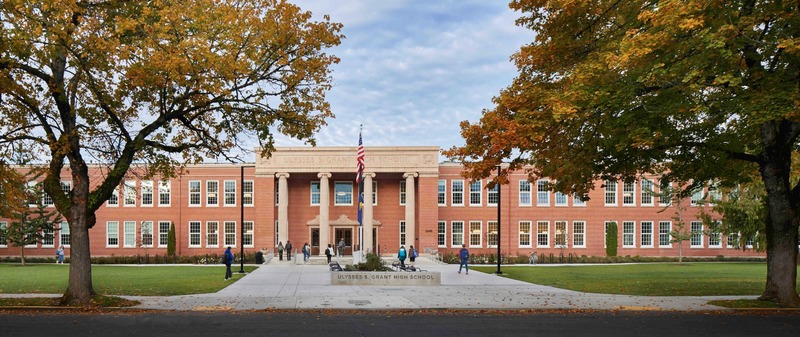
Why would one part of Portland be doing well and another not so well? I think the close to downtown neighborhoods like Laurelhurst, Alameda, Beaumont, Irvington, Sabin, King, Boise and Eliot areas are doing well because of proximity to the MAX, shopping, restaurants and popular destination streets like Mississippi and Alberta. Proximity to downtown has its benefits too: a short commute or a bike ride to work, and with Gas Prices around $4 per gallon, the residents of the suburbs are spending more of their budget on Gas. Furthermore, many close in NE Neighborhoods are in the Grant High School District, and Grant is a very highly regarded school.
If you know of any other reasons why Close In NE Portland is HOT, please post your comments.
I had the opportunity to sit down with Stephen Smith of Design Build Portland today, and we discussed the concept of ADU (accessory dwelling units) in Portland.
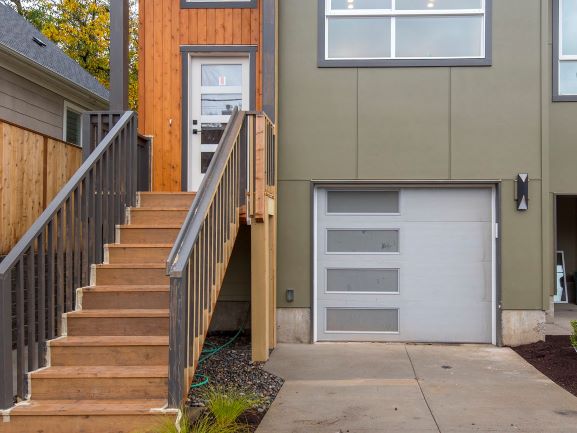
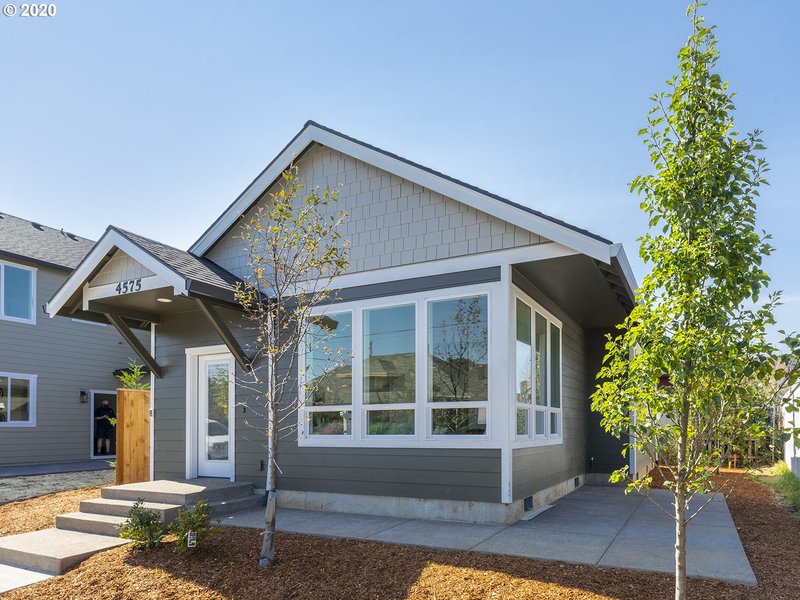
An ADU is what our urban planners in Portland call a mother-in-law apartment. It is an attached or detached structure that can be a maximum of 800sf. It can be a small house in the backyard of a larger house. It can be a garage apartment or it can be a basement or attic conversion.

The city of Portland loves ADU's because they increase city density which discourages urban sprawl, and the city has temporarily waived the system development fees for ADU's.
The cost to build an ADU varies greatly on the size and scope of the project, but about $100 to $120/square foot would be an average range. If the ADU is built as a new garage plus adu above it, the cost would be in the 80 to 100 range.
It takes 4 to 6 months to build an ADU, because designs have to be drawn up, the city has to approve the designs and then after about 2 months, they can start to build.

People in Portland love ADU's. They provide extra space for family, friends, or an office. They can also be used as rental units.
I have posted some video interviews with Stephen Smith on facebook: www.facebook.com/brianporterrealestate
Stephen will be at an open house at his most recent ADU project on Sunday May 29th at 4227 NE 10th Ave.
Cooperative Short Sales. Really?

When I first heard the term cooperative short sale, it reminded me of terms like friendly foreclosure, or even worse friendly fire, but as it turns out banks are trying to find a macro-solution to short sales.
A cooperative short starts with a phone call from the homeowner to the bank. The homeowner explains to banker that he or she has suffered a hardship, and will no longer be able to make the mortgage payments. The Banker and the homeowner will probably discuss a loan modification, and in fact, this may be a pre-requisite to entering into a cooperative short sale. Once the bank has determined that a loan modification is not a viable option, and after documents have been presented to the bank that show the home owner's hardship, the bank is not left with any good options, so they are taking the lesser of two evils... the cooperative short sale.
The cooperative short sale is less bad for the bank than a foreclosure because it is less expensive than a foreclosure; it is quicker than a foreclosure and it doesn't tarnish the bank's reputation as much as a foreclosure. Furthermore banks don't want to have abused bank owned (REO) properties on their balance sheet. The bottom line is: it makes financial, legal and good PR sense for banks to close out non-performing loans this way.
Homeowners can benefit from this type of short sale because the bank waives its right to go after the seller for the deficiency, and the seller may walk with $2,500 to $3,000 in cash. Furthemore, the homeowner doesn't have the stigma of a foreclosure on his or her record.
The next step in the process is for the Bank to order an appraisal. The property is then listed with a Realtor at the appraised value of the house, and the Bank agrees to sell the property at the appraised price (or lower?). The short sale is pre-approved, so the acceptance of offers only takes a day or two, not the 6 months that we are used to waiting. I think I need to repeat that: It only takes one or two days for the bank to accept offers! As if that weren't enough, the Bank understands that the appraisal may have come in high, and if the property doesn't sell in 21 days, the price gets lowered every 21 days until an offer comes in, or the property is foreclosed upon.
Bank of America is pioneering the concept of cooperative foreclosures, but other banks may be exploring these options as well. I am working on a cooperative short sale at this moment, and I will make some posts along the way to update readers about the process.
There are a lot of crappy overpriced homes on the market right now, and they will continue to languish until the price is low enough to entice an investor buyer to fix up the property.
On the other hand, there is a dearth of nice, high quality homes at reasonable prices. So the first step to getting multiple offers on a home is listing the home at market value, or even a tiny bit below market value. By doing this, you will get the attention of buyers who have been waiting for the right house to come on the market.
Second, the house needs to be very clean, in good condition and free from major defects. If you want to get several offers on a property at market value, it needs to stand out as the clear quality leader in the neighborhood. Fresh paint goes a long way, but the houses that get noticed also feature new windows, refinished hardwoods and a new roof. These are important maintenance items that homeowners need to take care of before listing their home.
Putting your home on the market is like entering a beauty contest, and these upgrades can help you win.
If the house is vacant, staging is very important to motivate buyers to write offers. Of the last 4 vacant houses that I have had staged, 3 have received multiple offers. This is anecdotal evidence, I know, but I am starting to notice a trend here.
Taking quality photographs of your beautifully staged home will also attract attention and motivate buyers to take a closer look. If your photos are not great, you won't get the traffic you need in order to get more than one offer.
Landscaping is important too. A new front yard that looks like a carpet might cost $1,000 to install, but it will provoke a strong response from buyers. I have seen this happen on a couple of listings recently.
Yes you can get multiple offers on beat up houses too... by offering them at prices that are attractive to investors. Real estate investors are always looking for properties that have good profit potential, and when a home is offered for sale at a wholesale price, the investors will flock to the property and get an auction going.
Sometimes bank owned (REO properties) are priced at below market values, and the offers come pouring in. I wrote an offer for a client on a 4-plex last year, and it was a de facto auction situation. We wrote an above asking price offer, but another party offered way above asking price. The bank was able to move the property quickly at market value for investors. Win/Win.
One more thing that is so obvious to me, but may not be obvious to all is: List the property with a REALTOR. They have tools tools and the skills to get your property sold for top dollar.
If you want to sell your house in Portland, get top dollar and hopefully get MULTIPLE OFFERS, give me a call. 503-810-2219
Brian
Old Portland Home in Buckman Neighborhood, $374,000
This 3BR, 1 1/2 bathroom home has been cared for and tastefully updated. Even though this house is over 100 years old, it is move in ready. The home features a formal dining room, a breakfast bar, hardwoods, built ins, lots of windows, great light and a nice backyard. There is lots of useable space in the basement including a family or media room.
2260 Square Feet of interior space on a 4100 Square Foot Lot in the fabulous close-in southeast Portland Buckman neighborhood. Close to great restaurants, bars, shopping, busline and just a few minutes by bike or car to downtown Portland.
This is one of those rare listings that is really worth looking at. The pride of ownership shows.


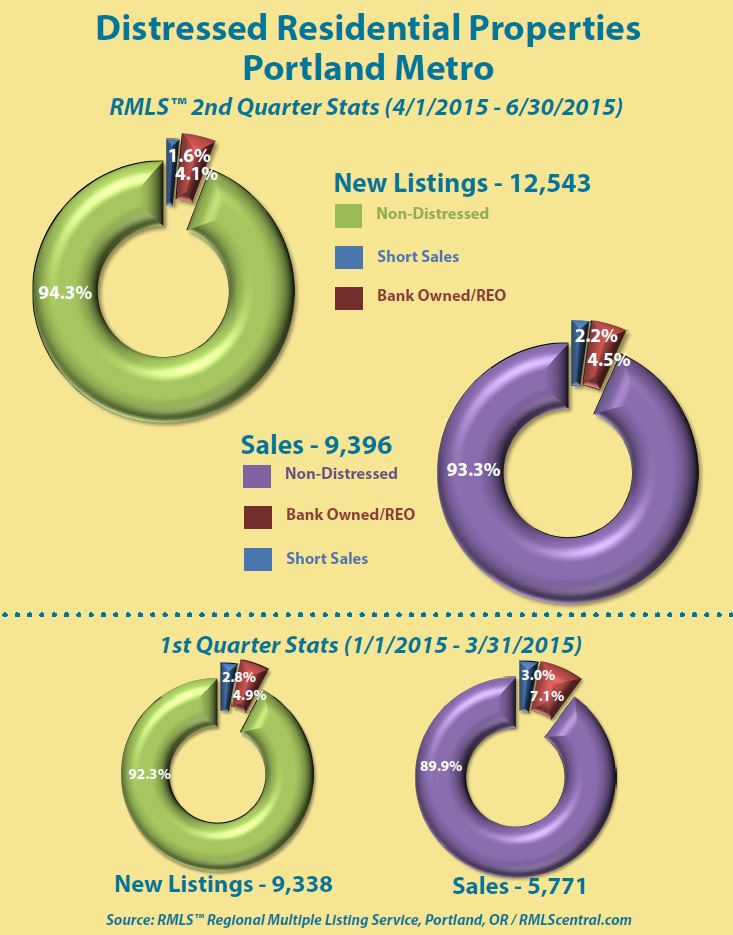
How important is the Distressed Property market?
Everywhere you turn these days in real estate, you see terms like Bank Owned, Short Sale, Auction or Distressed Property. Are distressed properties driving Portland Real Estate? Well not exactly. Distressed properties are playing an important role, but they are not the leading source of sold of homes in Portland. In the past 30 days, 63% of the properties sold were traditional sales. That is one property owner selling his or her property to another without bank intervention.
Bank Owned properties came in 2nd place in terms of units sold, and they captured 28% of the market, and Short Sales when the seller owes more than the property is worth, was only 9% of the sold units. The combined Bank Owned and Short Sales categories accounted for 37% of sales, so a little over a third of the sales in the past 30 days were Distressed.
Bank owned properties were the cheapest at $110/sf and the average sale price was $167,000. The average price of a short sale home was $235,000 at $135/sf. Traditional sales averaged $159/sf and $316,000.
Some observations: the average sale price of traditional sales came in at almost double that of bank owned properties. This is largely due to the fact that it is the lower priced neighborhoods that have been hardest hit by the real estate crisis. The close-in and established high-end neighborhoods have not seen large numbers of short sales and bank owned sales. In general the closer the property is to downtown, the lower importance and influence of distressed properties.
In today's insane real estate market, you see and write a lot of lowball offers. I have been selling Real Estate in Portland Oregon since 2003, and I have written my fair share of low offers. Most low offers get rejected because the seller is looking to get a certain price, but once in a while you get one accepted. Here are some things that you can do to make your lowball more appealing to the seller:
- Put down a large amount of earnest money
- Make your earnest money non-refundable and immediately available to the seller
- Schedule the closing ASAP
- Eliminate contingencies, for example, eliminate the inspection contingency
- Don't ask for any special favors, for example don't ask for a home warranty
- Show the seller that you will be able to financially close the transaction
- Take on the seller's problem, ie., accept the house with all of its defects
- Be very careful writing a letter that "explains" your lowball offer. You might insult the seller
- Respect the seller's needs, for example, allow him to rent back for a while if needed
- Write lowball offers on properties that have motivated sellers, for example, vacant properties, properties that cannot be financed and properties that have been on the market for a long time
With regard to the letter that "explains" your lowball offer, the only time that I was successful, I wrote an offer for my client that explained that the buyer really loved the home, but it was beyond their reach financially. I explained that they could afford a certain price and nothing more, and it worked!
My friend Millard Christner from John L. Scott told me that if you are humble, respectful and empathetic when you write the offer, you will get a better result, and he also said that if you write a letter of explanation, make it brief. Furthermore he said that your offer should convey the fact that you are willing to take on all of the seller's problems when you write the lowball offer, and all the seller has to do is sign the papers.
You may have to write more than one low offer before you get one accepted, but this is a legitimate way to negotiate a lower price on a property. You just have to have the stomach for it. You may also find yourself playing ping-pong. That is: offer, counter offer, counter to counter etc. This can be a huge waste of time, but as long as there is movement on the part of the buyer and seller, it is probably worthwhile to continue.
A few don'ts would include:
- Don't write more than one offer at a time, unless you plan on purchasing more than one property.
- Don't try justify a low offer by sending the listing agent "comparable properties". I tried this on one occasion, and it did not go over well at all.
- Don't insult the seller or disrespect the property; you will just burn bridges.
- Don't write a low offer on a new listing; you will be wasting your time .
- Don't write a low offer on an underpriced listing. You might loose the opportunity to pick up a steal.
Portland Real Estate Market Action, January 2011
The 2010 numbers are in, and they were not pretty. When January 2011 numbers are compared to January 2010, there was a decline of 11.9% in average sale price. The median price was also down 10.4% over the same time period. On the positive side, the inventory of homes was lower in January 2011 vs. 2010; it came in at 11.3 months compared to 12.6 last year. In order for a real estate recovery to begin, excess inventory needs to be soaked up by buyers.

Market times continue to be long… around 160 days, and this number is worse than a year ago, when it was 145 days.
Average sale prices of homes in Portland are approximately the same as is January 2005.

People ask me almost every day, “When will the market recover?†or “Are we at the bottom yet?†I usually answer “maybeâ€, but nobody really knows when the local market will really recover. 2011 will be a great year for certain types of buyers… buyers who want to move up into bigger or nicer home, first time buyers who plan on holding the property for a few years, investors who are looking for rental property and investors who resell real estate. These buyers will be able to get a lot of value in 2011.
The story for the real estate market in 2011 is affordability: the combination of low prices with low interest rates.

Graphs and data used in this article were provided by RMLS.
I was previewing property for an out of town buyer this weekend, and I visited the Eliot Tower. It really is a beautiful building, and it is in one of my favorite spots in Portland... right across the street from the Portland Art Museum. It is also next door to Safeway, and it has a Boyds coffee on the same building. The address of the Eliot is 1221 SW 10th, and the streetcar runs along SW 10th.
_resize.jpg)
The interiors of condos depend greatly on the owner's finishes and decoration, and the unit that I saw was nicely decorated and had a nice view of the west hills. It was a little dark however due the fact that it only had windows on one wall. The building lobby, library, concierge desk and gym, are world class. The only other building that I have seen on this level or above for all of these ammenities is the Metropolitan.

Currently there are 10 condos for sale at the Eliot Tower out of 223 units. The average price per square foot for these properties is $482, and the median days on market for these units is 97 days.

The only drawback, in my opinion, to the Eliot Tower is that it is a pretty large building, and there are a lot of units that only have windows on 1 wall. Because of this, some units do not have a lot of light. Smaller buildings like the Benson, have more corner units as a percentage of the total number of units, so on average they have more light.
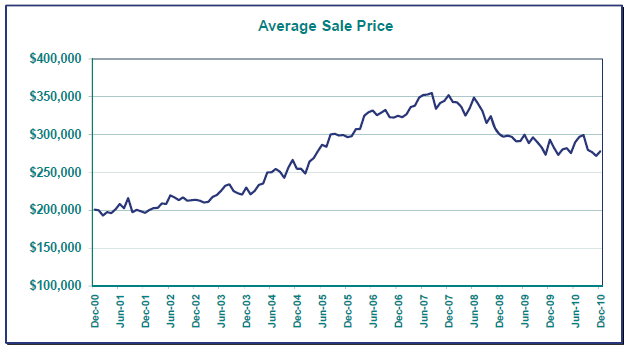
As promised, this blog post will be more robust including graphs and current market data. This first graph shows us the average sales price of homes in the Portland Metro Area for December 2000 to December 2010. As expected, this graph shows is that prices peaked in 2007, and that there has been a 20 to 25% decline in the average prices of homes. One little bump up in prices, that I would like to mention is the June 2010 peak where prices jumped up partially due to the tax credit. Also, this graph shows that we are in a valley right now, and this may be attributed to the seasonal nature of real estate in Portland. In the winter, prices drop because of seller fatigue. In the summer prices tend to go up because seller optomism.
I would like to make a few comments about the next graph that covers inventory. By the way, as per RMLS, "Inventory in Months is calculated by dividing the Active Listings at the end of the month in question by the number of closed sales for that month". In other words, if no new houses come on the market, it would take X number of months to sell the current inventory. This number shows us if we are in a buyer's market, seller's market or equilibrium. The current inventory of 7.9 months is virtually the same as this time last year, and nearly half that if the previous year. This leads me to believe that 2011 will be more closely resemble 2010 in terms of sales and appreciation (depreciation) than previous years. "The average sale price for December 2010 declined 5.2% compared to December 2009. The median sale price also fell 5%." --RMLS Prices continued to fall in 2010; however, depreciation was at a much slower rate than in 2008 and 2009.
I find this graph interesting because it show the "bubble" perfectly in terms of sales volume. Sale volume went crazy in 2003 to 2007 because of easy money and real estate speculation; however sale volume in 2010 is virtually the same has 2000 sans speculators.
The graphs on this page are from the RMLS Market Action for January 2011.
It is difficult to make a prediction about the Portland Real Estate market in 2011 because we do not know how the economy will fare this year. Unemployment is still high, economic growth is weak, the majority in congress has changed, state and local governments are facing huge deficits, the national debt is at an all time high, and there does not seem to be an end in sight for foreclosures and short sales. I am not going to fill up this post with statistics and graphs. I am going to make some observations about the market on a more personal and anecdotal level.
Currently, I am involved in about 6 real estate transactions, and all of them are non-traditional sales. When I say non-traditional sales, I am referring to short sales, auctions, bank owned properties (REO's) or lease options. In 2010, many of the transactions that I closed were non-traditional. There has been a downward spiral in prices since the local peak in 2007 that has been fed by distressed sales.
In 2010, we had a few months where things were looking better, partially due to the tax credit that brought a sense of urgency to the market, and partly due to pent up demand for homes. Some people have been waiting for the bottom form before getting back into the market, and in the summer of 2010, to some people, it looked like a bottom was forming, so they decided to buy. The good news is that the rate of depreciation slowed significantly is 2010.
There are a few likely scenarios for 2011. We might have a double dip recession, and if this happens, we would expect real estate values to decline. The economy might improve on a national level in 2011, and real estate values might stabilize and even appreciate a little. We might see some inflation in 2011, and property values might get caught up in an inflationary wave; they might rise if real estate is seen as a safe haven. Interest rates might rise significantly in 2011, and that would put downward pressure on real estate values.
In some parts of the country, real estate values have stabilized quite a bit, and in some parts of California real estate values appreciated in 2010. Portland was late to come to the real estate crash party, so it stands to reason that we will be among the last to leave. If we are a year behind our neighbor California, then 2011 might not be so bad.
The positive side of buying real estate right now is: affordability is high, you can get a lot for your money (payment) and bargains abound for investors. I am working with investors right now who are able to "flip" properties right now by buying low, fixing up the house, and selling at market value. For people who have steady employment and income, it is a good time to lock in low interest rates on houses that have dropped significantly in value. For long term investors, there are opportunities to buy rental property that will cash flow positive with the required down payment. Now is not the time to buy if you are a speculator who believes that prices will go up... they might not.
_resize.jpg)
_resize.jpg)
_resize.jpg)
_resize.jpg)